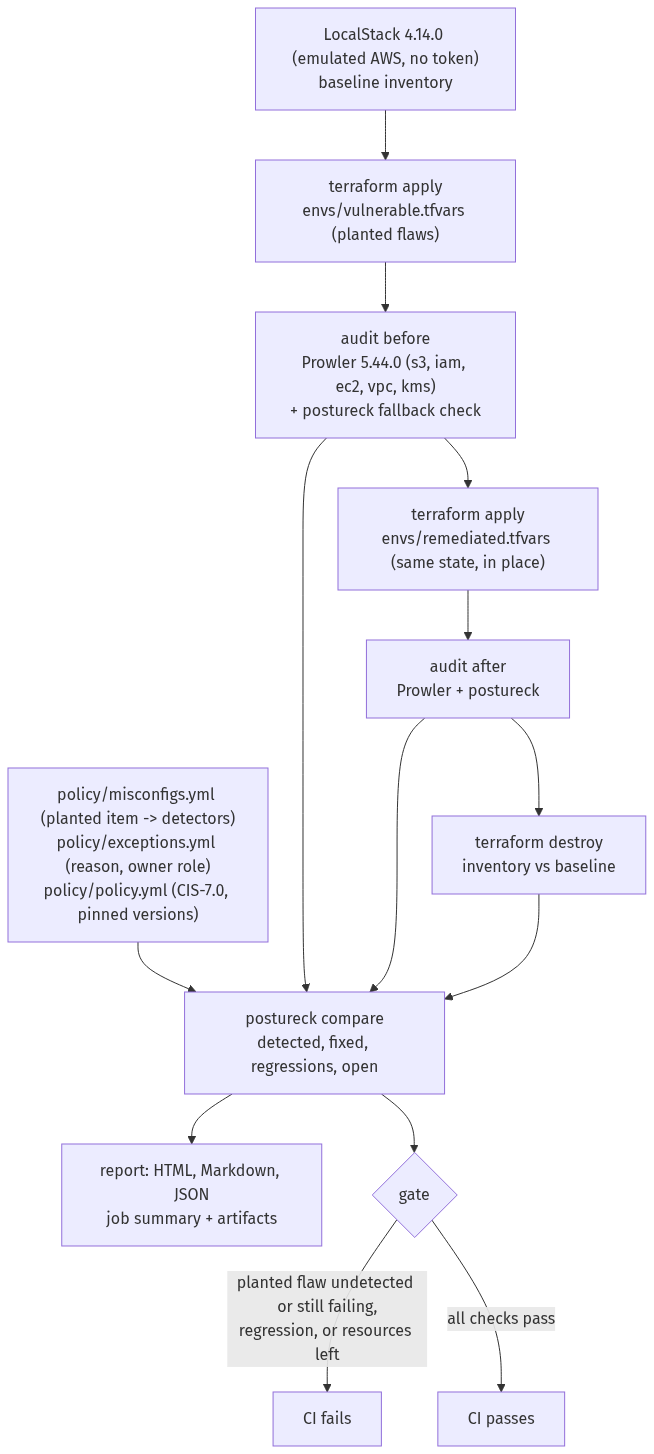
TL;DR: A small company's hand-built AWS account is rebuilt with Terraform on LocalStack, with documented misconfigurations planted on purpose: a public bucket, customer data not encrypted with the company's key and unversioned, an everything-on-everything policy, a long-lived key without MFA, a weak password policy, SSH and RDP open to the internet, an open default security group, a key without rotation and a VPC without flow logs. Prowler audits the account before and after a Terraform fix; CI fails unless every planted flaw was detected and then cleared, nothing new appeared and the teardown left nothing behind. The CI runs are real; the AWS account is emulated (LocalStack); no real AWS account is used.
| Role played | Cloud security engineer reviewing a small company's AWS account |
| Environment | Public GitHub repository, GitHub-hosted Ubuntu runners, LocalStack 4.14.0 (community edition) |
| Tools | Terraform 1.16 + AWS provider 6.67, Prowler 5.44.0, Checkov, Python 3.12, boto3, moto, pytest, ruff, mypy, tflint, shellcheck, gitleaks |
| Deliverable | Terraform for a vulnerable and a remediated posture, planted flaws as data, audit-compare-gate tool (postureck), CI, branch ruleset, demo PRs |
1. Problem
Small companies often set up their cloud account by hand, under time pressure, and never review it: a bucket opened "for a minute", a deploy user with full rights, a key that never expires, the database port open for a contractor. An audit tool lists hundreds of findings; what is missing is a way to prove that the flaws that matter were found, that the fix removed them, and that the fix did not open something else.
2. Design
- The account as code. Terraform builds the account in two postures from the same resources: one variable per
planted flaw switches it on (
envs/vulnerable.tfvars) or off (envs/remediated.tfvars). Both apply to the same state, so the remediation is an in-place change — the way a real fix lands. - Planted flaws as data.
policy/misconfigs.ymllists each planted part, its CIS AWS Foundations id and the checks that must catch it. The roles of the tools are fixed in advance: a flaw that nobody detects is a finding about the audit, not a pass. - An independent auditor. Prowler does the auditing. Where Prowler has no check for a planted flaw on the
emulator, a small fallback check in
postureckcovers it, and every finding names the tool that produced it. - Matching that does not drift. Findings are keyed by (check, resource). Security groups, VPCs and keys have random ids, so they are matched by their exact Name tag, which Prowler reports as a label. After the fix, each planted item is judged on the exact (check, resource) pairs that failed before: a renamed tag, a PASS on some other resource or one detector going silent cannot make a flaw look fixed.
- A teardown that is checked. The emulator ships its own sample resources, so the teardown is compared with an inventory taken before anything was created.
3. The cycle
- Start LocalStack (pinned by digest) and take the baseline inventory.
terraform applythe vulnerable posture.- Audit: Prowler on S3, IAM, EC2, VPC and KMS with unused resources included (the emulated account has no workloads), plus the fallback check.
terraform applythe remediated posture on the same state.- Audit again.
terraform destroy; the inventory must match the baseline.postureck reportcompares and writes HTML, Markdown and JSON;postureck gatedecides.
4. Measurement and gate
- Detection rate: planted items whose detectors failed before the fix (an item with two parts counts when both were detected). Fix rate: planted items that pass after the fix (an excepted part does not count as fixed).
- Regressions: a (check, resource) failing after the fix that was not failing before.
- Open: failing before and after, not planted — reported, not gated.
- Gate (exit 1): a planted flaw not detected; a planted flaw still failing, or its detector silent, after the fix; any regression, even when the totals fell; resources left after teardown.
- Errors, not results (exit 2): LocalStack not healthy, a Terraform step failed, Prowler wrote no output, a findings file is unreadable, or a deployed service has no finding from any tool.
5. Planted misconfigurations
| Item | Misconfiguration | CIS v7.0 | Detected by |
|---|---|---|---|
| 1 | Assets bucket publicly readable, Block Public Access off | 3.1.4 | Prowler |
| 2a | Customer data not encrypted with the company's KMS key | outside CIS 7.0 | Prowler |
| 2b | Customer data bucket unversioned and reachable over HTTP | 3.1.1 | Prowler |
| 3 | Policy allowing every action on every resource, attached to a user | 2.14 | Prowler |
| 4a | Long-lived access key on a user without MFA | 2.10 | postureck |
| 4b | Weak account password policy | 2.8, 2.9 | Prowler |
| 6a | SSH and RDP open to the internet | 6.3 | Prowler |
| 6b | Default security group allows traffic | 6.5 | Prowler |
| 7a | KMS key without rotation | 4.6 | Prowler |
| 7b | VPC without flow logs | 4.7 | Prowler |
Item 5 of the plan, a missing CloudTrail, is not planted: the LocalStack edition that runs without a token has no CloudTrail service.
6. Pipeline
| Job | What it proves |
|---|---|
lint |
terraform fmt/validate, tflint (AWS ruleset), ruff, mypy (strict), shellcheck, yamllint |
unit |
postureck on fixtures cut from real Prowler output and on moto; terraform test with a mocked provider; coverage gate 90 % |
iac-scan |
Checkov on both postures, for comparison (not gating) |
audit |
the whole cycle on LocalStack; artifacts: Prowler output, fallback findings, Terraform logs, inventories, report |
secrets |
gitleaks over the full history |
It runs on every pull request, on pushes to main, weekly and on demand.
7. Results
From run 37812253346 (2026-10-08), the final code after the review fixes; the first green run, 37414269426 on main (2026-10-06), gave the same numbers. docs/example-report.html
is its report. LocalStack 4.14.0 (community edition, pinned by digest), Prowler 5.44.0, Terraform 1.16.5 with the AWS
provider 6.67.0, CIS AWS Foundations v7.0 as Prowler maps it.
| Before the fix | After the fix | |
|---|---|---|
| Planted items detected | 6 / 6 (all 10 parts) | — |
| Planted items passing | 0 / 6 | 6 / 6 (all 10 parts) |
| Regressions | — | 0 |
| Resources left after teardown | — | 0 |
- Every planted part was caught by the tool assigned to it: nine by Prowler, one (the access key without MFA) by the fallback check, because Prowler only checks MFA for users with console access.
- Failing findings by CIS section (the planted parts and everything else Prowler reports on the five services): section 2 (identity) 7 → 3, section 3 (storage) 6 → 4, section 4 (logging and keys) 3 → 1, section 6 (networking) 11 → 8.
- Open findings: read the totals with care. 1,201 findings fail both before and after the fix. Only 20 of them are on the lab's own resources — controls outside the planted set, such as replication, lifecycle rules, object lock, access logging and MFA delete on the two buckets, hardware MFA on the deploy user — and they are reported, not hidden. The other 1,181 belong to the emulator itself: 1,159 are "EBS snapshot not encrypted" on LocalStack's built-in sample snapshots, which exist before the lab creates anything. That is also why the severity totals barely move (high 1,181 → 1,171): the gate judges the planted items, regressions and teardown, not the totals.
- Time: the audit step takes about 3 minutes (two Terraform applies, two Prowler scans of about 30 seconds each, a destroy); the whole pipeline 4–6 minutes.
How it got there. The first complete cycle
(run 37413720116) detected 6/6 but fixed 5/6, and found one regression. The default security
group kept its rules after the "fix": Terraform treats empty rule blocks as "not specified", so nothing was removed —
the rules are now written as an explicit empty list. And the regression was real: the IAM role the fix created for
VPC flow logs could be assumed on behalf of any account (no aws:SourceAccount condition). The fix had introduced a
new weakness, and the regression check is what found it.
Static scan, for comparison. Checkov, run on both postures, did not report the SSH/RDP rule open to the internet in either of them: the address range comes from a conditional value it does not resolve. The live audit did.
Demo pull requests (closed unmerged; the ruleset blocks the merge):
| PR | Change | What happened |
|---|---|---|
| #1 | SSH and RDP open to the internet again in the remediated posture | detected 6/6 but fixed 5/6: the gate failed with "planted flaw still failing after fix: P6a" |
| #2 | the "fix" also creates a new public bucket, acme-exports |
every planted item was still fixed (6/6), but the gate failed on 12 regressions on the new bucket, among them public access (critical) and Block Public Access off (high) |
8. Lessons
- The free emulator moved. Current LocalStack releases refuse to start without an account token; the last tokenless release (4.14.0, community edition) works, but it has no CloudTrail — so one of the planted flaws had to go, and the write-up says so rather than faking it.
- "Scan only what is used" hides an emulated account. By default Prowler skips resources nothing uses; in an account without workloads that means the security groups and the VPC were never checked. The audit scans unused resources on purpose.
- A compliance filter is not the audit. Running Prowler with
--compliancelimits it to that framework's checks; scanning by service keeps every check and still records the CIS mapping on each finding. - Defaults change what can be planted. S3 now encrypts every bucket with SSE-S3 by default, on AWS and on the emulator, so "no encryption at all" cannot be planted; the item became "not encrypted with the company's own key".
- A fix can open something new. The flow-logs role the remediation added could be assumed on behalf of any account; the totals still went down, and only the regression check (a finding absent before, failing after) caught it.
- Empty is not the same as "remove". Terraform treats empty rule blocks on the default security group as "not specified" and leaves the old rules in place; an explicit empty list removes them. A plan with mocked providers cannot show this — the real apply and the second audit did.
- Random ids need names. Security groups, VPCs and keys come back with random ids; tagging them with a Name and matching on Prowler's labels is what lets a planted flaw be followed from before to after.
9. Limits
- The target is emulated AWS (LocalStack 4.14.0 community), not a real account; results show that the method works, not the posture of any real account.
- Prowler's coverage on the emulator is partial; the report names the tool behind each finding.
- Not testable here: CloudTrail, root-account controls, GuardDuty, Security Hub, Organizations.
- The emulator ships sample resources (for example EC2 snapshots); their findings fail before and after and inflate the totals. The planted items, regressions and teardown are what the gate judges.
10. Reproduce it
Fork the repository and enable Actions: every push runs the cycle. Locally (Linux, macOS or WSL with Docker,
Terraform and Python 3.12), follow the README's quick start: bash scripts/run-audit.sh writes out/report.html and
out/results.json.
11. Mapping
| Framework | Items |
|---|---|
| CIS AWS Foundations v7.0 | 2.8, 2.9, 2.10, 2.14, 3.1.1, 3.1.4, 4.6, 4.7, 6.3, 6.5 |
| CIS Controls v8 | 3.3 configure data access control lists, 3.11 encrypt sensitive data at rest, 4.4 and 4.5 firewalls on servers and end-user devices, 5.4 restrict administrator privileges, 6.5 require MFA for administrative access, 13.6 collect network traffic flow logs |
| MITRE ATT&CK | T1530 Data from Cloud Storage, T1078.004 Valid Accounts: Cloud Accounts, T1562.007 Impair Defenses: Disable or Modify Cloud Firewall — what the fixed settings make harder |