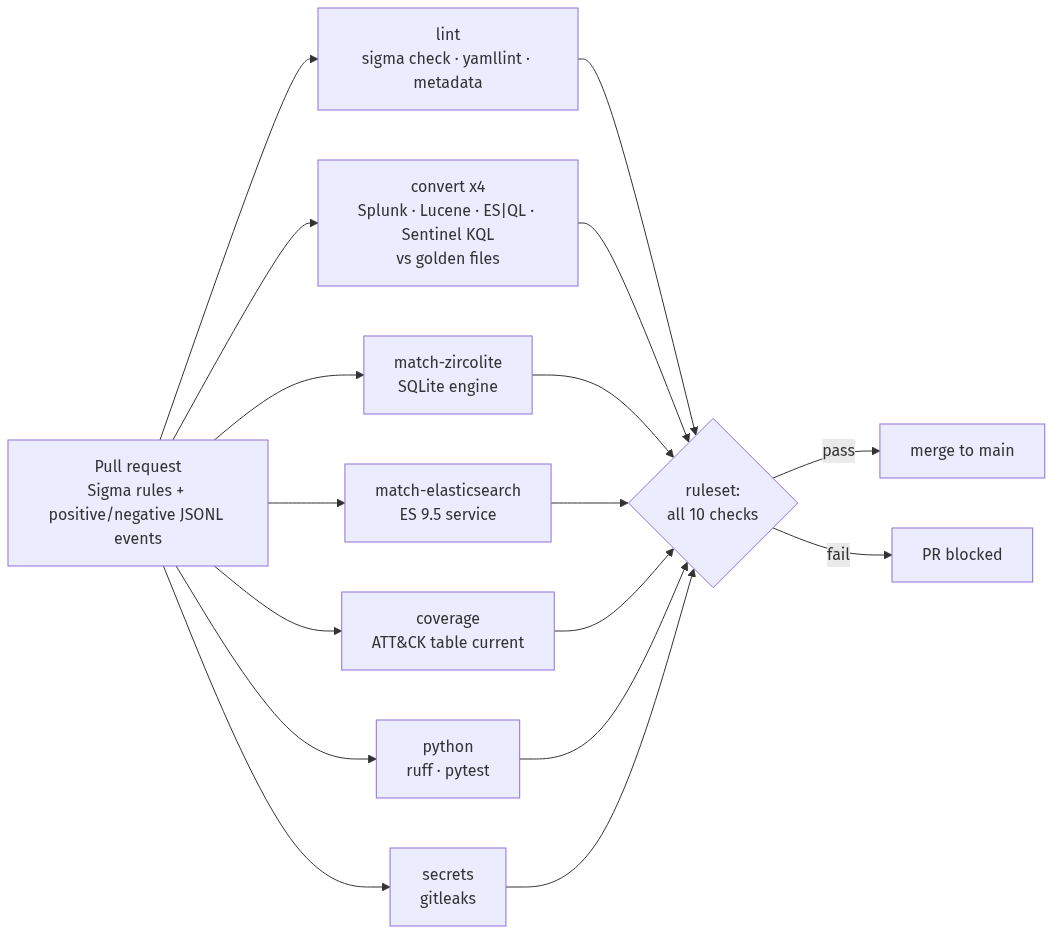
TL;DR: Fifteen ATT&CK-mapped Sigma rules (seven Windows, three Linux auditd, five Azure) live in Git and are tested like code. Every pull request lints them, converts them to four SIEM query languages and compares the output with committed "golden" files, and executes them against positive and negative sample events on two engines (Zircolite and Elasticsearch). A branch ruleset blocks the merge unless all ten checks pass. The CI runs are real; the sample events are synthetic, hand-written from documented log schemas.
| Role played | Detection engineer turning a handful of SIEM searches into a reviewed, tested rule repository |
| Environment | Public GitHub repository, GitHub-hosted Ubuntu runners, Elasticsearch 9.5.3 service container |
| Tools | Sigma, sigma-cli 3.1.0 / pySigma 1.5.1, Zircolite 4.1.0, Elasticsearch, Python, pytest, gitleaks |
| Deliverable | 15 rules, 68 fixture files, golden conversions, 7 CI jobs (10 checks), branch ruleset, 2 demo PRs, results |
1. Problem
Detections rot quietly. A field renamed in a parser, a typo in a rule, or an edit that makes a rule "catch more" does not fail anything; the SIEM just stops alerting, or starts alerting on everything. Writing rules once as vendor-neutral Sigma and treating them like code (reviewed, versioned, tested on every change) turns those silent failures into red pull requests.
2. The rules
| Platform | Rule | ATT&CK |
|---|---|---|
| Windows (Sysmon 1) | PowerShell started with an encoded command | T1059.001 |
| Windows (Sysmon 10) | LSASS process memory opened with read access | T1003.001 |
| Windows (Security 4732) | Member added to the local Administrators group | T1098 |
| Windows (Sysmon 1) | Scheduled task created with schtasks | T1053.005 |
| Windows (Security 1102) | Security event log cleared | T1685.005 |
| Windows (Sysmon 1) | Volume shadow copies deleted | T1490 |
| Windows (System 7045) | Service installed from a user-writable path | T1543.003 |
| Linux (auditd EXECVE) | Reverse shell through /dev/tcp or /dev/udp | T1059.004 |
| Linux (auditd PATH) | SSH authorized_keys file created or modified | T1098.004 |
| Linux (auditd PATH) | Cron persistence file written | T1053.003 |
| Azure Activity | Owner or User Access Administrator role assigned | T1098 |
| Azure Activity | NSG rule allows inbound traffic from the Internet | T1686.001 |
| Entra audit | Conditional Access policy created, changed or deleted | T1556 |
| Azure Activity | Mass resource deletion by one caller (correlation rule) | T1485 |
| Entra sign-in | Successful sign-in from a country outside the allow-list | T1078 |
The five Azure rules re-express the hand-written KQL detections of Lab 05 (Azure landing zone) in Sigma. Every rule
carries a description, references, false-positive notes and a level, and check_metadata.py enforces this in CI.
Tags follow ATT&CK v19.
3. The pipeline
- lint:
sigma check(validators on, ATT&CK data pinned to v19.2), yamllint, and a metadata/fixture check. - convert: each rule is converted to Splunk SPL, Elastic Lucene, ES|QL and Sentinel KQL, and the output is
diffed against
tests/expected/. A change in a rule, a pipeline or a backend version shows up as a reviewable diff of the generated query. - match-zircolite and match-elasticsearch: every fixture file is run through two engines. Positive files must fire on every event (on the correlation rule, at least one alert), negative files are near misses that must stay silent. Two engines because a query can be right in one and wrong in another: Elasticsearch keyword fields are case-sensitive unless normalised, while Sigma is case-insensitive. The Elasticsearch engine runs a raw-field Lucene conversion (not the ECS-mapped golden) on a test index whose strings are lowercase-normalised.
- coverage keeps the README ATT&CK table and a Navigator layer in sync with the rule tags; python tests the scripts; secrets runs gitleaks over the full history.
4. Declared gaps
Not every rule converts to every target, and the pipeline says so instead of skipping quietly. support.yaml
lists each gap with its reason: the correlation rule (no Lucene or kusto support), four Windows rules that the
Sentinel microsoft_xdr mapping has no table for, and the auditd rules (no standard Sentinel table). CI re-runs
every "unsupported" conversion and fails once it starts working, so the list cannot go stale.
5. Sigma vs the hand-written KQL in Lab 05
| Detection | Lab 05 KQL | Converted from Sigma (tests/expected/kusto/) |
|---|---|---|
| Privileged role assignment | Parses the request body and checks RoleDefinitionId |
Properties contains "<role GUID>": a substring match on the whole properties blob, coarser |
| NSG open to the Internet | Parses the rule JSON and checks direction, access and source prefix | Substring matches on compact JSON: breaks if the body is formatted differently |
| Conditional Access change | Same operations; no filter on the result | Same operations, plus Result =~ "success", so failed attempts no longer alert |
| Mass resource deletion | summarize count() by Caller over the rule's 15-minute period |
No KQL: the kusto backend does not support correlation rules (Splunk and ES |
| Sign-in outside allowed countries | Allow-list US; skips empty Location |
Allow-list CO, US; no empty-Location check, so it would fire on sign-ins with no location |
Sigma buys portability and testability. What it costs is the precision of hand-written KQL wherever the data is nested JSON.
6. Results
All numbers below come from GitHub Actions runs on 2026-09-30.
Baseline run on main (run 36758372626,
commit b2357e6): all 10 checks passed on the first run, in about one minute wall-clock (jobs run in parallel;
the slowest, match-elasticsearch, took 56 s including the service start).
| Check | Result |
|---|---|
lint |
sigma check: 0 errors, 0 issues; metadata OK |
convert (4 jobs) |
0 errors each: 15 Splunk, 14 Lucene, 15 ES|QL and 7 KQL queries equal their golden files |
match-zircolite |
64 fixture files, 0 failures |
match-elasticsearch |
58 fixture files, 0 failures (the correlation rule's 6 files are a declared skip) |
python |
76 unit tests passed |
coverage, secrets |
passed |
Both mixed-case positives (PowerShell.EXE -ENC, SCHTASKS /CREATE) fired on both engines. On the Elasticsearch
side that holds for this repo's test index, where every string is lowercase-normalised. It says nothing about the
committed ECS goldens: they are not executed, and on a standard ECS index their process.command_line wildcards
and ES|QL like / == comparisons are case-sensitive (per Elastic's documentation; not tested here).
Ruleset 24264960 on main: pull request required, all 10 checks required and up to date, linear history, no
force pushes or deletion.
Two demo pull requests, both blocked (closed unmerged). Each one also refreshed the golden files, as a real author would, so the converters had nothing to object to: every generated query was valid.
| PR | Change | What failed | Merge |
|---|---|---|---|
| #2 | Over-broad edit: the schtasks rule no longer requires /create |
match-zircolite and match-elasticsearch: negatives neg-query (schtasks /query) and neg-delete fired, 2 failures on each engine (run) |
Blocked |
| #3 | Field-name typo: TargetSid → TargetUserSid |
Both match jobs: positive admin-added no longer matched, 1 failure on each engine (run) |
Blocked |
The other eight checks passed on both PRs. That is the point: lint and conversion alone would have let both changes through.
After the final-review fixes (PR #5, run 36767918569): all 10 checks passed; Zircolite 68 fixture files and Elasticsearch 62, 0 failures on each; 79 unit tests. The four new fixtures cover the review's findings (section 7).
7. Lessons
- The negative fixtures earned their place first. The NSG rule as first written matched every source: a bare
*inside a Sigma value is a wildcard, so"sourceAddressPrefix":"*"matchedVirtualNetworktoo. The near-miss fixture caught it before the rule ever reachedmain; the asterisk is now escaped. - Lint against a pinned ATT&CK. pySigma validates tags against the ATT&CK
masterbranch. Mid-build that was v19, which split Defense Evasion and renumbered techniques, andsigma checkbegan failing on tags that were valid the day before. The check now uses a versioned ATT&CK file at a fixed commit. - Mappings can silently change a rule. Sending Security-log rules to Sentinel's
SecurityEventtable through a custom pipeline looked like it worked, but combined withmicrosoft_xdrit dropped theEventIDcondition (the 4732 query would also match 4733). Reading the generated query made that visible, and the gap is now declared instead. - Types matter across backends. Writing
ResultTypeas a number satisfied the Sigma validator but producedResultType == 0in KQL, a type error against a string column. - Correlation semantics differ by engine. Splunk and ES|QL conversions count in fixed 15-minute buckets. Zircolite uses a sliding window and catches a burst from 13:10 to 13:19 that, reading the queries, the fixed buckets would split 5 + 5.
- Engines have quirks. Zircolite strips underscores from field names, and a correlation rule only converts when it is in the same file as its base rule.
- A second reader finds the variants you didn't write down. The final review found three gaps the fixtures did
not cover: PowerShell accepts every prefix of
-EncodedCommand(-Encodedslipped through), a dumper renamedMsMpEng.exeoutside Defender's folder bypassed the LSASS filter, andbash -l -cputs the payload ina3. Each became a positive fixture that failed first, then passed once the rule was fixed.
8. Limits
- The events are synthetic. The tests show each rule matches what it claims and ignores its near misses. They do not measure false-positive rates on real telemetry, which needs a baseline in a live environment.
- No Wazuh conversion (out of scope, on the roadmap).
- Elasticsearch is exercised only in CI (Docker service); Zircolite runs locally too.
- What Elasticsearch executes is a raw-field Lucene conversion on a lowercase-normalised test index. The ECS-mapped Lucene and ES|QL goldens, Splunk and KQL are generated and diffed, not executed.
- The auditd rules assume decoded records: raw auditd hex-encodes EXECVE arguments that contain spaces, so the
collector must interpret them first (
ausearch -i, laurel or auditbeat).
9. Reproduce it
- Fork the repository and enable GitHub Actions.
- Apply
.github/rulesets/main.jsonas a branch ruleset (Settings → Rules → Import). - Locally:
python -m venv .venv,pip install -r requirements-dev.txt, then run the commands in the README. - Open a pull request that edits a rule and watch the ten checks.
10. Mapping
- MITRE ATT&CK v19: 14 techniques across 7 tactics (table and Navigator layer in the repository).
- NIST CSF 2.0: DE.CM (continuous monitoring) and DE.AE (adverse event analysis): detections as maintained, tested assets.