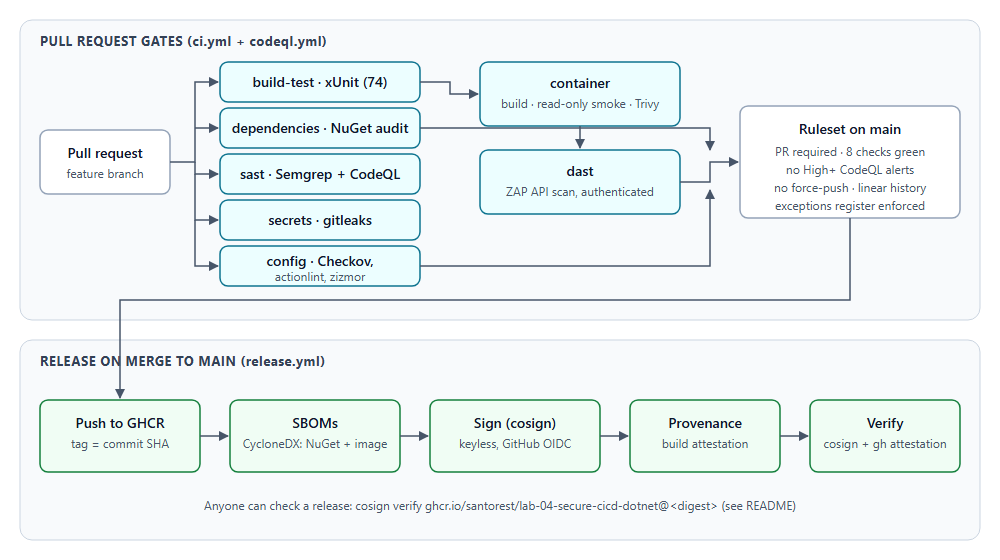
TL;DR — A small ASP.NET Core ticketing API and a GitHub Actions pipeline in which every pull request must pass seven security gates (tests, vulnerable dependencies, SAST, secrets, workflow and Dockerfile configuration, container CVEs, and an authenticated DAST scan) before a branch ruleset lets it merge, and every merge ships a signed container image with SBOMs and build provenance that anyone can verify. Six deliberately broken demo pull requests show the gates blocking real problems (the config gate and Semgrep blocked none of them; section 6 shows what did). Everything here ran for real on GitHub-hosted runners; all numbers come from those runs.
| Role played | DevSecOps engineer building the delivery pipeline for a small API team |
| Environment | Public GitHub repository, GitHub-hosted Ubuntu runners, GitHub Container Registry |
| Tools | .NET 10, xUnit, CodeQL, Semgrep, gitleaks, Checkov, actionlint, zizmor, Trivy, OWASP ZAP, CycloneDX, cosign |
| Deliverable | API + tests, ci.yml / codeql.yml / release.yml, branch ruleset, exceptions register, demo PRs, results |
1. Problem
- Context: a small team ships an internal helpdesk API. Code review alone doesn't catch a vulnerable transitive package, a secret pasted into a config file, an injectable query or an outdated base image — and nobody can prove which build produced the image running in production.
- Goals:
- Block those problems on the pull request, automatically, before they reach
main. - Make exceptions explicit: every accepted finding has a reason, an owner and an expiry date.
- Make every release verifiable: signed, with a bill of materials and build provenance.
- Block those problems on the pull request, automatically, before they reach
- Constraints: free tooling only, no long-lived signing keys, no secrets available to pull-request jobs.
2. The API
A ticket API on ASP.NET Core 10 (minimal APIs, EF Core with SQLite):
POST /api/auth/loginissues a 15-minute JWT (HMAC-SHA256). Passwords are hashed with ASP.NET Core Identity; logins are rate-limited (5 per minute per IP) and accounts lock after 5 failures. Unknown users and wrong passwords get the same answer.- Users see and create their own tickets; agents see all of them and move them through
open → in_progress → resolved → closed, one step at a time. Another user's ticket answers 404, not 403, so IDs can't be probed. - Every response carries
Content-Security-Policy: default-src 'none',X-Content-Type-Options,Referrer-Policy,Cross-Origin-Resource-Policy, noServerheader, andCache-Control: no-storeunder/api. Errors are RFC 9457 problem details with no stack traces; bodies over 64 KB get 413. - The container runs Microsoft's chiseled .NET image (no shell, no package manager) as a non-root user
with a read-only root filesystem; only
/data(the SQLite file) and an in-memory/tmpare writable. - 74 .NET tests (15 unit, 29 integration, 30 repo-policy), including forged, expired,
alg: none, wrong-issuer and wrong-audience tokens, cross-user access, and bad paging input.
3. Pull-request gates
| Gate | Tool | Blocks when |
|---|---|---|
| build-test | dotnet build (warnings are errors) + xUnit |
a build warning or a failing test |
| dependencies | NuGet audit during restore; Dependabot | a High/Critical advisory, direct or transitive |
| sast | Semgrep (p/csharp, p/secrets); CodeQL security-extended in its own workflow |
a Semgrep ERROR finding; a High+ CodeQL alert (enforced by the ruleset) |
| secrets | gitleaks, full history of the commit under test | any finding |
| config | Checkov (Dockerfile, workflows), actionlint, zizmor | any finding |
| container | image build, read-only smoke test, Trivy | a fixable High/Critical CVE |
| dast | OWASP ZAP API scan, authenticated, driven by the OpenAPI document | a High alert, or a Medium on the fail list |
The pipeline protects itself too: every third-party action is pinned to a full commit SHA and every scanner image to a digest (Dependabot proposes updates), workflows default to read-only permissions, checkouts don't keep credentials, and pull-request jobs get no secrets — the DAST job generates its own throw-away signing key and test user for each run.
Branch ruleset on main: changes only through pull requests; all 8 checks green and up to date; no
High+ CodeQL alerts; no force-push or deletion; linear history. It stores 0 required approvals because a single
maintainer can't approve their own pull request — a team would set 1+ approvals and CODEOWNERS review. A
direct git push to main is refused:
remote: error: GH013: Repository rule violations found for refs/heads/main.
remote: - Changes must be made through a pull request.
remote: - 8 of 8 required status checks are expected.
4. Exceptions process
A finding can be accepted instead of fixed only with a row in security/EXCEPTIONS.md: tool, rule, scope,
reason, owner and expiry date. A repo-policy test runs in build-test and fails the PR when a suppression
exists in any tool's own format (NuGet, Trivy, Semgrep, ZAP, Checkov, gitleaks) without a register row, when a
row has no suppression, or when a row has expired. The register currently has one entry: EX-001, Checkov
CKV_DOCKER_2 (no HEALTHCHECK): the chiseled image has no shell or curl to run one, so /health is probed
from outside instead; it expires on 2027-03-31.
5. Release and verification
On every merge to main, release.yml pushes the image to GHCR tagged with the commit SHA, generates two
CycloneDX SBOMs (NuGet dependencies and the whole image), signs the image with cosign keyless signing
(GitHub's OIDC identity — no keys to store or leak), attaches the SBOM as a signed attestation, records
build provenance, and then verifies all of it the way an outsider would:
cosign verify ghcr.io/santorest/lab-04-secure-cicd-dotnet@<digest> \
  --certificate-identity https://github.com/santorest/lab-04-secure-cicd-dotnet/.github/workflows/release.yml@refs/heads/main \
  --certificate-oidc-issuer https://token.actions.githubusercontent.com
gh attestation verify oci://ghcr.io/santorest/lab-04-secure-cicd-dotnet@<digest> --owner santorest
The first release was also verified from a separate Windows machine with cosign v3.1.3, and the same check with another repository's identity fails, as it should; both commands and their exit codes are in results/cosign-verify.txt.
6. Results
All figures come from results/results.json, generated from the public GitHub API by
tools/collect_results.py on 2026-09-29.
Pipeline time (successful full CI runs on main, i.e. runs with every gate):
| Median | Runs | |
|---|---|---|
| Full CI pipeline (wall clock) | 282 s (4 min 42 s) | 6 |
| build-test | 33.5 s | 6 |
| dependencies | 26.5 s | 6 |
| sast (Semgrep) | 28 s | 6 |
| secrets | 12 s | 6 |
| config | 27.5 s | 6 |
| container | 66.5 s | 6 |
| dast (ZAP) | 167.5 s | 6 |
| Release (sign, SBOMs, provenance, verify) | 82 s | 7 |
Demo pull requests (each adds one deliberate problem; closed unmerged — details in docs/demo-prs.md):
| Demo | Deliberate problem | Stopped by |
|---|---|---|
| — | AWS-style key pair (random, never valid) | GitHub push protection, at git push, before CI |
| #7 | Generic API key in a config file | secrets (gitleaks) |
| #3 | System.Text.Json 8.0.4 (CVE-2024-43485, High) |
dependencies (NuGet audit) — and build-test, CodeQL |
| #4 | SQL built by string concatenation | build-test: EF Core analyzer EF1003 |
| #8 | Same, with the analyzer warning silenced | CodeQL cs/sql-injection (High) + ZAP SQL Injection (High); PR blocked |
| #5 | Unpatched aspnet:10.0.0-noble base image |
container: 15 fixable High CVEs (Trivy) |
| #6 | Content-Security-Policy header removed |
build-test: integration test (DAST never needed) |
Findings on the real code and what happened to them:
| Finding | Tool | Outcome |
|---|---|---|
Cross-Origin-Resource-Policy header missing (rule 90004) |
ZAP | Fixed, with a test; the next scan passed 118/118 rules |
No HEALTHCHECK in the Dockerfile (CKV_DOCKER_2) |
Checkov | Accepted as EX-001, expires 2027-03-31 |
| 8 Medium CVEs in base-image OS packages | Trivy | Below the gate (not High/Critical); tracked in code scanning; Dependabot proposes base-image updates |
| gitleaks scanned every branch, so the demo key on one branch failed unrelated PRs | pipeline design | Fixed (PR #9): scan only the history of the commit under test |
| CodeQL, Semgrep, NuGet audit, gitleaks, actionlint, zizmor on the real code | — | 0 findings |
7. Lessons
- Layers catch what single tools miss. Semgrep's C# rules didn't flag the concatenated SQL and its secrets rules didn't flag the generic API key; the EF Core analyzer, CodeQL, ZAP and gitleaks did. No one tool would have caught all six demos.
- Cheap checks run first. Two demos never reached the container and DAST jobs: an integration test and a
compiler analyzer stopped them in
build-test, within about 35 seconds. - Push protection is the first gate. GitHub refused the AWS-style key before any CI ran.
- Scanners need scoping. A full-history secret scan that fetched every branch let one branch's leak fail everyone's PRs — found by a demo, fixed by scanning only the commit under test.
- Workflows are code and need linting. An unquoted colon in a step name and a wrongly formatted Checkov input both broke CI on the way; the config gate (actionlint, zizmor, Checkov) now checks every workflow change.
- Pin, then check the pin. The latest release of the Checkov GitHub Action still pulled Checkov 2.0.930; running the official image pinned by digest gave the current version.
8. Reproduce it
- Fork the repository and enable Actions.
- Apply the ruleset:
gh api --method POST repos/<you>/<repo>/rulesets --input .github/rulesets/main.json. - Open a pull request: the seven CI gates and CodeQL run. Merge it: the release runs.
- Verify the image with the commands in section 5 (replace the owner and repository).
- Locally: .NET 10 SDK,
dotnet test; collect results withpython tools/collect_results.py <owner/repo>.
9. Mapping
| Control | Framework | Where |
|---|---|---|
| PW.7 Review and analyze code / PW.8 Test executable code | NIST SSDF | sast, CodeQL, build-test, dast |
| PS.2 Verify release integrity / PS.3 Archive and protect each release | NIST SSDF | cosign signature, provenance, SBOMs in GHCR |
| PO.3 Secure toolchains | NIST SSDF | pinned actions and images, least-privilege workflows, zizmor |
| Verification: Security Testing; Implementation: Secure Build | OWASP SAMM | gates, exceptions register |
| 16.4 / 16.12 Third-party components, code-level security checks | CIS Controls v8 | NuGet audit, Dependabot, SAST |
| Build L2 (signed, hosted-build provenance) | SLSA v1.0 | release.yml |