TL;DR: A SQL Server and a PostgreSQL database are backed up to a local share and to an object-storage bucket with Object Lock. A scripted ransomware drops both databases, wipes the share and uses the stolen backup key against the bucket; both databases are then restored from the immutable copy alone to clean hosts, verified, and the achieved RPO and RTO are measured against written targets. A runbook and a tabletop exercise complete it. Everything runs in GitHub Actions against containers. The CI runs are real; the data is synthetic.
| Role played | Database / security engineer responsible for recoverability of a small clinic's databases |
| Environment | Public GitHub repository, GitHub-hosted Ubuntu runners, SQL Server 2025 and PostgreSQL 18 containers, MinIO (Chainguard build) |
| Tools | Python 3.12, boto3, native SQL Server backups, pg_basebackup + WAL archiving, sqlcmd, pg_amcheck, pytest, ruff, mypy, shellcheck, gitleaks |
| Deliverable | Backup shipping and restore toolkit (drkit), ransomware drill, measured RPO/RTO with a gate, DR runbook and tabletop (EN/ES), CI, branch ruleset, demo PRs |
1. Problem
Ransomware operators go after the backups first: a backup that the compromised servers can reach, or that the stolen backup credentials can delete, is gone when it is needed. "We have backups" is not a recovery plan; a recovery plan says how much data and how much time the business can lose, keeps at least one copy that the attacker cannot destroy, and proves — regularly, with numbers — that the databases come back within those limits.
2. Design
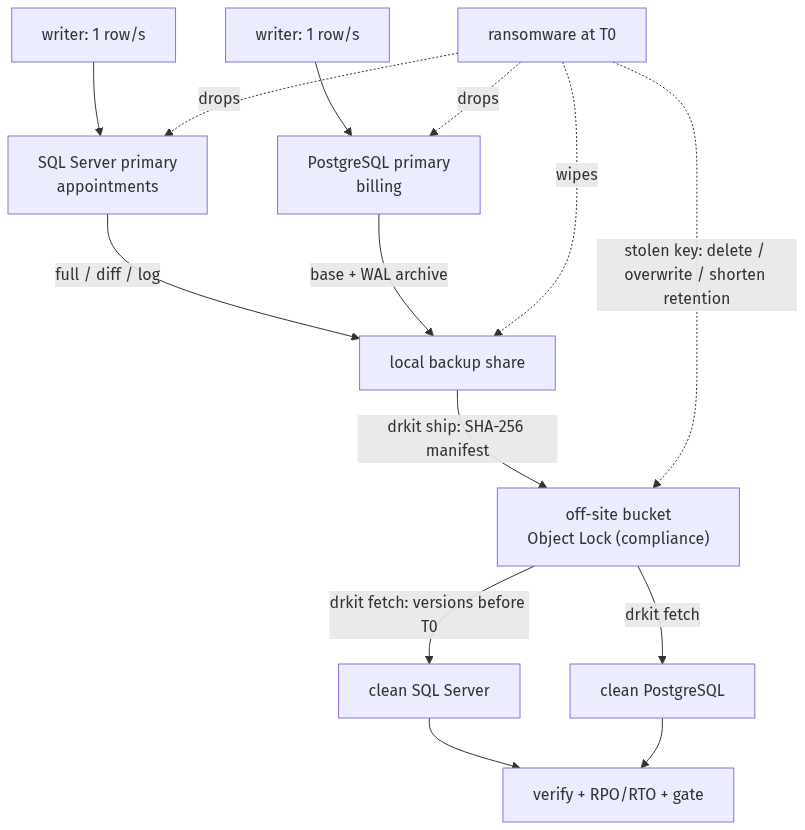
- Two tiers. Native backups land on a local share (fast to restore from, but reachable). Every finished file is shipped to an off-site bucket with Object Lock in compliance mode: until the retention date no one can delete a locked version or shorten its retention — not the backup key, not an administrator.
- The key is not the protection. The backup writer key is allowed to delete objects and versions. If deletion were blocked only by permissions, whoever steals a more privileged key could still do it; the lock does not depend on who asks.
- Manifest with versions. Every shipped file is recorded with its object version and SHA-256; the manifest is shipped and locked too. Recovery fetches each file by version, so an attacker's overwrite (a newer version) or delete marker changes nothing.
- The last safe point. Recovery only reads object versions the store wrote before T0, the start of the attack. Anything later may be the attacker's.
- Compressed time. The schedule runs at one policy minute per real second. RPO, which depends on the backup interval, is measured in real seconds and converted to policy minutes for the comparison; RTO, which depends on the restore work, is not compressed.
3. The drill
- Two primaries with a writer each (one row per second: the ground truth for data loss).
- SQL Server: full at policy minute 0, log backups every 15, a differential at 360. PostgreSQL: a base backup and
continuous WAL archiving.
drkit shipcopies each finished file to the bucket. - At T0 (policy minute 400) the ransomware stops the backup agent, drops both databases, wipes the local share and, with the stolen key, tries on every object version: shorten retention, delete the version, overwrite, delete.
drkit fetchbuilds each restore chain from the bucket alone — newest full, newest later differential and every later log (a missing log number is an error); base backup and contiguous WAL from its start segment (a missing segment is an error) — downloads by version id and checks every SHA-256.- Restores on clean containers, then
DBCC CHECKDB/pg_amcheckand a check that the restored rows are contiguous.
4. Measurement
- Achieved RPO = T0 − the newest row in the restored database: data actually lost, read from the data.
- Achieved RTO = from "recovery declared" to "restore verified", wall clock.
- Gate: fails on a missed target, a restore that is not verified, or any original version lost off-site.
5. Runbook and tabletop
The runbook (docs/runbook.md) gives the roles, four decision points — is the data trustworthy, restore in place
or to clean hosts, which restore point is the last safe one, when to return to service — and the per-engine
procedures with the commands the drill runs, so CI exercises the runbook on every run. The tabletop
(docs/tabletop-ransomware.md) is a written exercise with timed injects (the backup share encrypted too, extortion,
pressure to restore the newest backup) and the expected decisions; it has not been run with people.
6. Pipeline
| Job | What it proves |
|---|---|
lint |
ruff, mypy (strict), shellcheck |
unit |
the pure modules on fixtures and a fake versioned store with Object Lock: chain gaps, stale differential, post-T0 versions, checksum mismatch, attack and survival, RPO/RTO edges, report escaping; coverage gate 90 % |
drill |
the whole cycle on both engines; artifacts: report, attack log, manifests, restore chains, timings |
secrets |
gitleaks over the full history |
It runs on every pull request, on pushes to main, weekly and on demand. A ruleset on main requires a pull
request and all four jobs.
7. Results
From run 37044822230 on main
(2026-10-02, final code); docs/example-report.html is its report. The first green run,
37043674073, gave the same outcome
(appointments RPO 11.1 min, RTO 2.1 s; billing RPO 1.8 min, RTO 59.7 s; 0 versions lost). After the final-review
fixes, run 37049627002 passed the new
checks — no destructive request accepted, PostgreSQL replay reached the last fetched WAL segment — with the same
picture (appointments RPO 11.0 min, RTO 2.5 s; billing RPO 2.4 min, RTO 39.8 s; 0 versions lost).
| System | RPO target | RPO achieved | RTO target | RTO achieved | Verified |
|---|---|---|---|---|---|
appointments (SQL Server) |
≤ 15 min | 10.5 min (10.5 s real) | ≤ 30 min | 2.5 s | DBCC CHECKDB clean, 352 rows contiguous |
billing (PostgreSQL) |
≤ 5 min | 2.5 min (2.5 s real) | ≤ 60 min | 39.7 s | pg_amcheck clean, 387 rows contiguous |
- Backups shipped before T0:
appointments1 full (528 KiB), 1 differential (196 KiB), 26 log backups (828 KiB);billing1 base backup (4.2 MiB) and 389 WAL files (388 segments plus a backup label, 8.9 MiB compressed). Restore chains used: full + differential + the 3 log backups after it; base + 386 contiguous WAL segments (plus the backup label file). - The attack: with the stolen backup key the ransomware made 3,184 attempts on the 796 original object versions.
All 796 retention shortenings and all 796 version deletes were refused
(
InvalidRequest: Object is WORM protected and cannot be overwritten); the 796 overwrites and 796 plain deletes were accepted but only added new versions and delete markers on top. 0 original versions lost. - Why the RPO is what it is: SQL Server lost the rows written after the last log backup (policy minute 390, the attack at 400): ~10 policy minutes. PostgreSQL ships WAL every policy minute, so it lost ~2.5.
- Why the RTOs are so short: the databases are small (hundreds of rows plus 500 synthetic records each) and the bucket is on the same network. The minutes do not transfer to production; the method does — RTO measured from "recovery declared" to "restore verified".
- Time in CI: the
drilljob takes 8–9 minutes (containers, a 400-policy-minute schedule in ~7 minutes, attack, parallel restores). - Images: SQL Server
2025-CU9-ubuntu-24.04@sha256:2b5b5816…, PostgreSQL18.6-trixie@sha256:5a5a84b1…, MinIOchainguard/minio@sha256:0f95aa41…, mcchainguard/minio-client@sha256:231c5976….
Demo pull requests (closed unmerged; the ruleset blocks the merge):
| PR | Change | What happened |
|---|---|---|
| #1 | off-site bucket without Object Lock | the stolen key deleted all 799 original versions; no manifest survived, so neither database could be restored; the gate failed (drill), and unit failed on the tests that pin the compliance lock |
| #2 | SQL Server log backups every 60 minutes instead of 15 | 6 log backups instead of 26, the last one 40 policy minutes before the attack; both restores were verified and nothing was lost off-site, but the achieved RPO was 41.3 min against 15 and the gate failed (drill); unit failed on the tests that pin the repository policy and timeline |
8. Lessons
- The tool you planned to parse changed. PostgreSQL 18's
pg_basebackup -vwith-X noneno longer prints the WAL start point; the backup's ownbackup_manifestrecords it (WAL-Ranges→Start-LSN), so the drill reads it from there. - Files written by one service are not readable by the next. SQL Server writes its backups as
0660owned by its own user, and PostgreSQL archives WAL as0600; the shipper on the host could read neither. Each backup is written to a.partfile, made readable, then renamed, so the shipper never sees a half-written or unreadable file. - The image you planned on can disappear. MinIO's own community container images are no longer published; the lab uses a maintained build (Chainguard) pinned by digest.
- A loop can lose its input to a child process. The first drill took one backup and then waited for the
attack:
docker compose exec, run inside awhile readloop, read the rest of the schedule from the loop's standard input. Each step now gets/dev/nullas its input. - "Refused" and "malformed" are different answers. The attack first tried to shorten the retention to now; MinIO answers a date that is not in the future as a malformed request, not as a refusal, which stopped the attack script. The attacker now asks for one minute from now — a real shortening, which the lock refuses.
- Object Lock behaves as documented, and that is worth proving. With a key that may delete versions, MinIO refused every delete of a locked version ("WORM protected and cannot be overwritten"); a plain delete only added a delete marker on top of the intact original.
9. Limits
- Containers and synthetic data; small databases, so the absolute RTO minutes do not transfer to production.
- Compressed time for the backup schedule (RPO converted back to policy minutes; RTO not compressed).
- MinIO stands in for cloud immutable storage (S3 Object Lock, Azure immutable blobs).
- The tabletop is written, not run with people.
- Not covered: backup encryption key management, VM and file-server backups, high availability.
10. Reproduce it
Fork the repository and enable Actions: every push runs the drill. Locally (Linux, macOS or WSL with Docker), follow
the README's quick start: bash scripts/run-drill.sh writes out/report.html and out/results.json.
11. Mapping
| Framework | Items |
|---|---|
| CIS Controls v8 | 11.1 establish and maintain a data recovery process, 11.2 perform automated backups, 11.3 protect recovery data, 11.4 establish and maintain an isolated instance of recovery data, 11.5 test data recovery, 17.4 establish and maintain an incident response process |
| MITRE ATT&CK | T1486 Data Encrypted for Impact, T1490 Inhibit System Recovery (attacks on the backups), T1485 Data Destruction — what the drill simulates and recovers from |